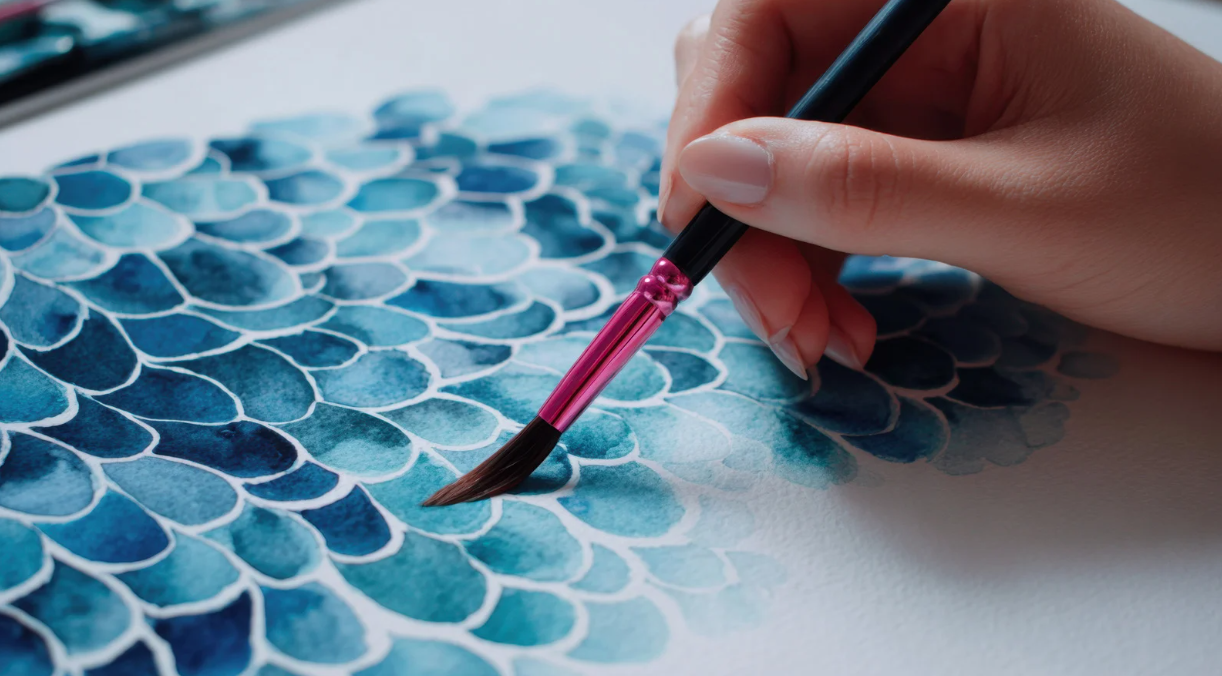

Brush control exercises form the backbone of confident painting and drawing. Without control, even the best ideas struggle to translate onto paper or canvas. Lines wobble. Paint spreads unevenly. Details feel forced instead of natural. Fortunately, control is not a talent you are born with. It is a skill built through focused, repeatable practice.
Think of brush control like learning balance on a bicycle. At first, every movement feels unstable. However, with repetition, your body adapts. The same principle applies here. As your hand learns pressure, speed, and direction, strokes become intentional rather than accidental.
Whether you work with watercolor, acrylics, ink, or digital tools, these brush control exercises strengthen precision while preserving creative freedom.
Why Brush Control Shapes Every Stroke You Make
Brush control determines how accurately your hand responds to your ideas. Even subtle movements affect stroke quality. Therefore, developing control improves not just technique, but confidence as well.
Artists often focus on materials. While quality tools help, they amplify skill rather than replace it. Strong control allows you to work efficiently with any brush. As a result, frustration decreases and creative flow increases.
For additional insight into how fine motor skills affect artistic performance, resources from The Smithsonian National Museum of Asian Art provide excellent context on traditional brush mastery:
https://asia.si.edu
Preparing Your Hand for Better Control
Before beginning any brush control exercises, preparation matters. Cold hands resist precision. Tension creates shaky strokes.
Start with relaxed posture. Loosen your shoulders. Rest your arm comfortably. Then warm up with slow, simple movements. Even two minutes of preparation improves responsiveness.
Many artists pair warm-ups with foundational drawing routines. If you already practice daily sketching, integrating control drills beforehand strengthens results. You can explore complementary practice ideas in our guide on daily art warm-up routines.
Line Control Exercises That Build Accuracy
Straight lines reveal everything. They expose hesitation, uneven pressure, and wrist tension immediately.
Begin by drawing horizontal lines across the page using one continuous stroke. Avoid correcting mistakes. Instead, observe them. Then repeat vertically and diagonally.
Next, vary your speed intentionally. Slow strokes train patience and precision. Faster strokes develop confidence. Over time, both approaches reinforce steadiness.
These brush control exercises create a technical foundation that supports shading, lettering, and detailed illustration.
Pressure Control for Expressive Strokes
Pressure defines personality in a stroke. Light pressure suggests softness. Heavier pressure creates emphasis.
Practice pressure ladders by starting each stroke lightly and gradually increasing pressure. Reverse the motion in the next stroke. Focus on smooth transitions rather than dramatic contrast.
Additionally, dot-based pressure drills sharpen sensitivity. Place evenly spaced dots while adjusting pressure subtly. This simple practice builds awareness quickly.
Pressure mastery transforms your brush into a responsive tool rather than an unpredictable one.
Curved Stroke Exercises for Fluid Motion
Curves train grace and continuity. They also expose stiffness instantly.
Practice drawing circles of varying sizes. Aim for smooth closures without overlap. Then move on to continuous figure-eight loops. Keep your wrist relaxed and motion fluid.
These brush control exercises improve rhythm and reduce rigidity. As a result, organic shapes and flowing lines feel more natural.
Controlling Stroke Length with Intention
Inconsistent stroke length often comes from hesitation. Length control solves this problem.
Mark two points on the page. Draw a single stroke connecting them without stopping. Repeat this exercise with varying distances.
This practice strengthens visual planning and execution. It also encourages commitment rather than correction.
Speed Variation to Improve Flow
Speed affects texture, thickness, and confidence. Therefore, learning to control it matters.
Alternate between slow and fast strokes on the same page. Compare results. Notice how grip tension changes with speed. Adjust consciously.
Brush control exercises focused on speed teach adaptability, which proves useful during complex projects.
Angle Awareness for Cleaner Results
Brush angle influences edge quality and paint distribution. Many artists overlook this factor.
Practice identical strokes at different angles. Observe changes in shape and control. Rotate the paper instead of your wrist when possible. This reduces strain and improves consistency.
Angle awareness expands both control and expressive range.
Negative Space Practice for Precision
Negative space exercises train accuracy through restraint.
Draw simple shapes, then paint around them without touching edges. This requires focus and steady control.
Over time, boundary awareness improves. Clean edges become easier to achieve in detailed work.
Pattern Repetition for Muscle Memory
Repetition builds reliability when practiced intentionally.
Fill a page with repeated patterns such as waves, zigzags, or parallel lines. Keep spacing and pressure consistent.
These brush control exercises strengthen muscle memory, allowing confident repetition without conscious effort.
Timed Drills for Realistic Practice
Art rarely happens under perfect conditions. Timed drills prepare you for real-world constraints.
Set a five-minute timer. Perform one exercise continuously. Focus on consistency rather than perfection.
This method builds endurance and maintains quality under pressure.
Applying Brush Control to Digital Art
Digital tools change texture, not fundamentals.
Practice line and pressure control using your stylus. Adjust sensitivity settings gradually. Zoom out regularly to evaluate stroke quality honestly.
Brush control exercises translate seamlessly between traditional and digital mediums.
Tracking Progress Without Losing Motivation
Improvement often feels subtle day to day. Save weekly practice pages. Compare older work monthly.
Visible progress reinforces motivation and confirms effectiveness.
For additional learning resources, Artists Network offers excellent technique-focused articles:
https://www.artistsnetwork.com
Blending Practice Into Creative Work
Practice should support creativity, not replace it.
Begin creative sessions with brief control drills. Then transition into expressive work while your hand is warmed up.
This integration allows technical improvements to appear naturally in finished pieces.
Conclusion
Brush control exercises develop confidence one stroke at a time. Through intentional repetition, awareness, and patience, your hand becomes steady and responsive. Over time, hesitation fades. Movement feels natural. Expression flows freely.
Control is not restrictive. It is liberating. When your brush obeys your intent, creativity finally leads.
FAQ
1. How often should brush control exercises be practiced?
Daily practice delivers the best results, even in short sessions.
2. Can beginners benefit from brush control exercises?
Yes. Beginners build stronger habits faster through early control training.
3. Do these exercises help with digital drawing?
Absolutely. The same principles apply to stylus-based tools.
4. How long until results become noticeable?
Most artists notice improvement within one to two weeks of consistent practice.
5. Are brush control exercises useful for lettering and calligraphy?
Yes. Improved control enhances consistency, spacing, and stroke quality.
Leave a Comment