
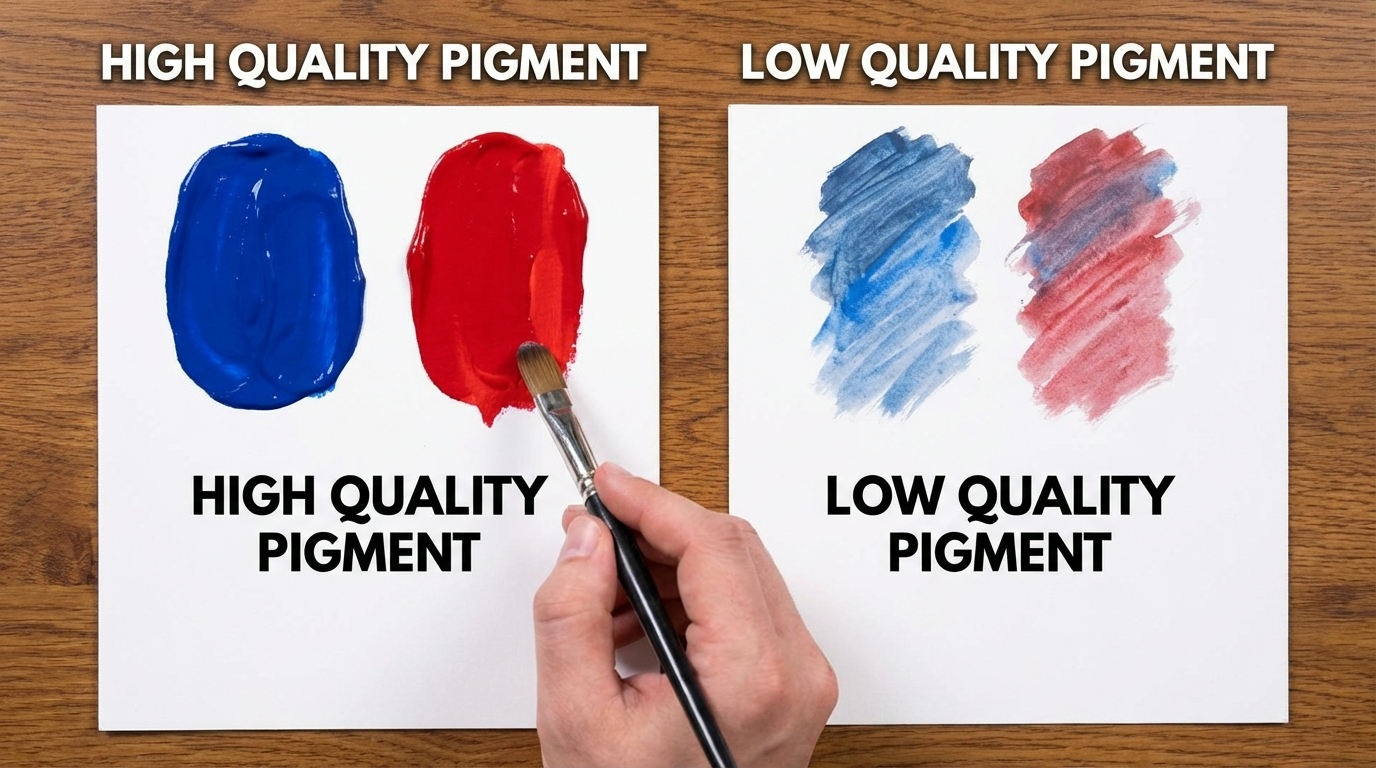

Understanding how pigment quality impacts your results can completely change the way you approach painting. Many artists focus on technique, yet materials matter just as much. In fact, pigment quality impacts color clarity, vibrancy, and mixing control more than most beginners realize.
When paints contain weak or overly processed pigments, mixtures often turn muddy. However, high-grade materials produce cleaner blends and stronger saturation. Therefore, learning how pigment quality impacts your mixing success becomes essential for artistic growth.
Instead of fighting dull colors, you gain confidence and control. As a result, your paintings look richer, more professional, and more intentional.
Why Pigment Purity Determines Mixing Clarity
Color mixing relies on chemical composition. When pigments remain pure and finely milled, they reflect light more efficiently. Consequently, blends appear vibrant rather than dull.
Lower-grade paints often include fillers. These additives reduce cost, yet they weaken intensity. Because fillers dilute the base pigment, mixtures lose brilliance quickly.
Additionally, impurity affects transparency. Clean pigments allow predictable glazing and layering. In contrast, contaminated mixtures create unexpected shifts.
For example, mixing a high-quality blue with a clean yellow produces a bright green. However, if either contains hidden undertones or fillers, the result turns grayish.
Therefore, pigment quality impacts not only brightness but also reliability. With professional-grade paints, your color experiments become consistent instead of frustrating.
Understanding Single Pigment vs. Mixed Pigment Paints
Paint labels often reveal important clues. Single-pigment paints contain one color source. Mixed-pigment versions combine several components.
Single-pigment options typically blend more cleanly. Because fewer compounds interact, unexpected muddiness decreases. As a result, color mixing feels more controlled.
Conversely, paints made from multiple pigments may create complexity. While this sometimes enhances nuance, it often complicates blending.
If you want predictable secondary and tertiary colors, choose tubes with clear pigment codes. Professional brands usually list this information.
When artists recognize how pigment quality impacts blending outcomes, they select materials more strategically. Over time, that awareness improves both skill and efficiency.
How Lightfastness Affects Long-Term Results
Color mixing success extends beyond immediate appearance. Durability matters as well.
Lightfast pigments resist fading over time. Therefore, paintings maintain vibrancy even under exposure to light.
Lower-quality pigments may look bright initially. However, they often degrade quickly. As a result, carefully mixed tones shift unpredictably.
Checking lightfast ratings ensures longevity. Professional-grade paints typically provide this data clearly.
Because pigment quality impacts archival stability, investing in reliable materials protects your work’s future. Artists who prioritize durability demonstrate professionalism and foresight.
The Role of Pigment Load in Color Strength
Pigment load refers to the concentration of color particles within paint. High pigment load produces stronger coverage and intensity.
Student-grade paints often contain less pigment and more binder. Consequently, mixtures appear weaker and require extra layering.
With professional-grade options, small amounts deliver powerful results. This efficiency improves control and reduces waste.
Furthermore, high pigment load enhances transparency when diluted. Glazes remain luminous instead of chalky.
Because pigment quality impacts saturation and opacity, understanding load differences helps you mix with precision. Over time, your confidence increases as colors behave predictably.
Why Cheap Paints Lead to Muddy Mixtures
Many beginners struggle with muddy colors. Often, the problem lies in materials rather than technique.
Lower-cost paints may combine multiple pigments to mimic a hue. When mixed with other colors, those hidden components clash.
For instance, a budget purple might contain red, blue, and white fillers. When blended with yellow, the result becomes dull brown.
Additionally, inconsistent milling produces uneven texture. Rough particles scatter light irregularly, reducing vibrancy.
Because pigment quality impacts clarity at a structural level, upgrading materials often solves persistent mixing problems immediately.
Testing Paint Quality Before Committing
Before investing heavily, conduct simple tests. Mix primary colors to evaluate brightness. Observe whether secondary hues appear clean or muted.
Next, create gradient swatches. Notice transitions between light and dark values. High-quality paints produce smooth shifts without chalkiness.
Also, examine drying results. Some low-grade paints darken or fade unpredictably. Professional pigments maintain consistency.
Through testing, you directly observe how pigment quality impacts performance. This hands-on evaluation prevents disappointment later.
Balancing Budget and Performance
Professional materials cost more. However, value depends on performance rather than price alone.
Because high-quality pigments require less product per stroke, tubes last longer. Moreover, reliable mixing reduces wasted paint.
For beginners, consider upgrading essential primaries first. Strong red, blue, and yellow pigments improve most mixtures.
Gradually replace weaker colors as budget allows. This incremental approach balances cost and improvement.
Recognizing how pigment quality impacts efficiency helps artists invest wisely rather than impulsively.
How Medium and Binder Interact With Pigments
Beyond pigment itself, binder composition influences results. Oil, acrylic, and watercolor mediums each interact differently with color particles.
High-quality binders suspend pigments evenly. Therefore, mixtures remain stable and luminous.
Lower-quality binders may separate or create uneven finishes. This inconsistency affects blending and layering.
Additionally, drying behavior varies by medium. Some acrylic binders darken slightly, while oils maintain tone. Understanding these shifts enhances accuracy.
Because pigment quality impacts mixing in combination with binder strength, choose reputable brands that balance both elements effectively.
Improving Technique Through Better Materials
Artists often blame themselves for poor mixing results. However, upgrading materials frequently reveals hidden potential.
When colors blend smoothly, confidence increases. Consequently, experimentation feels less risky.
Moreover, consistent performance allows focus on composition and expression rather than correction.
As technical frustration decreases, creative energy rises. Over time, stronger materials accelerate learning curves.
Recognizing how pigment quality impacts development empowers artists to remove unnecessary obstacles.
Building a Reliable Core Palette
A well-chosen core palette supports efficient mixing. Select high-quality primary pigments with proven lightfastness and purity.
For example, choose a single-pigment red, a clean blue, and a bright yellow. Add titanium white and a neutral dark if needed.
With these essentials, you can mix a wide spectrum confidently.
Because pigment quality impacts versatility, prioritize strength over quantity. A small collection of superior paints often outperforms a large set of weak options.
Long-Term Artistic Growth Through Material Awareness
Sustainable improvement depends on informed choices. Therefore, continue learning about pigment composition and performance.
Study manufacturer details and pigment codes. Experiment regularly to refine preferences.
As awareness grows, you develop an intuitive understanding of color behavior.
Ultimately, pigment quality impacts not only mixing success but also artistic confidence. When materials align with vision, creativity flows more freely.
Conclusion: Invest in Color That Supports Your Vision
Color mixing defines painting success. However, technique alone cannot overcome weak materials.
Because pigment quality impacts clarity, durability, and vibrancy, choosing professional-grade paints transforms results. Clean blends replace muddy tones. Stable hues protect long-term integrity.
By testing products carefully and upgrading strategically, you build a reliable foundation.
In the end, understanding how pigment quality impacts your creative process allows you to paint with greater control and confidence. Strong materials support strong art.
FAQ
- How can I tell if a paint contains a single pigment?
Check the label for pigment codes. Single-pigment paints usually list only one color index number. - Are student-grade paints always inferior?
They often contain fillers and lower pigment load, which may affect mixing clarity and vibrancy. - Why do my mixed colors look muddy?
Hidden pigments or low-quality materials often create unexpected undertones during blending. - Is lightfastness important for beginners?
Yes. Durable pigments prevent fading and protect your work over time. - Should I replace all my paints at once?
Not necessarily. Start by upgrading primary colors and expand gradually as needed.
Leave a Comment