
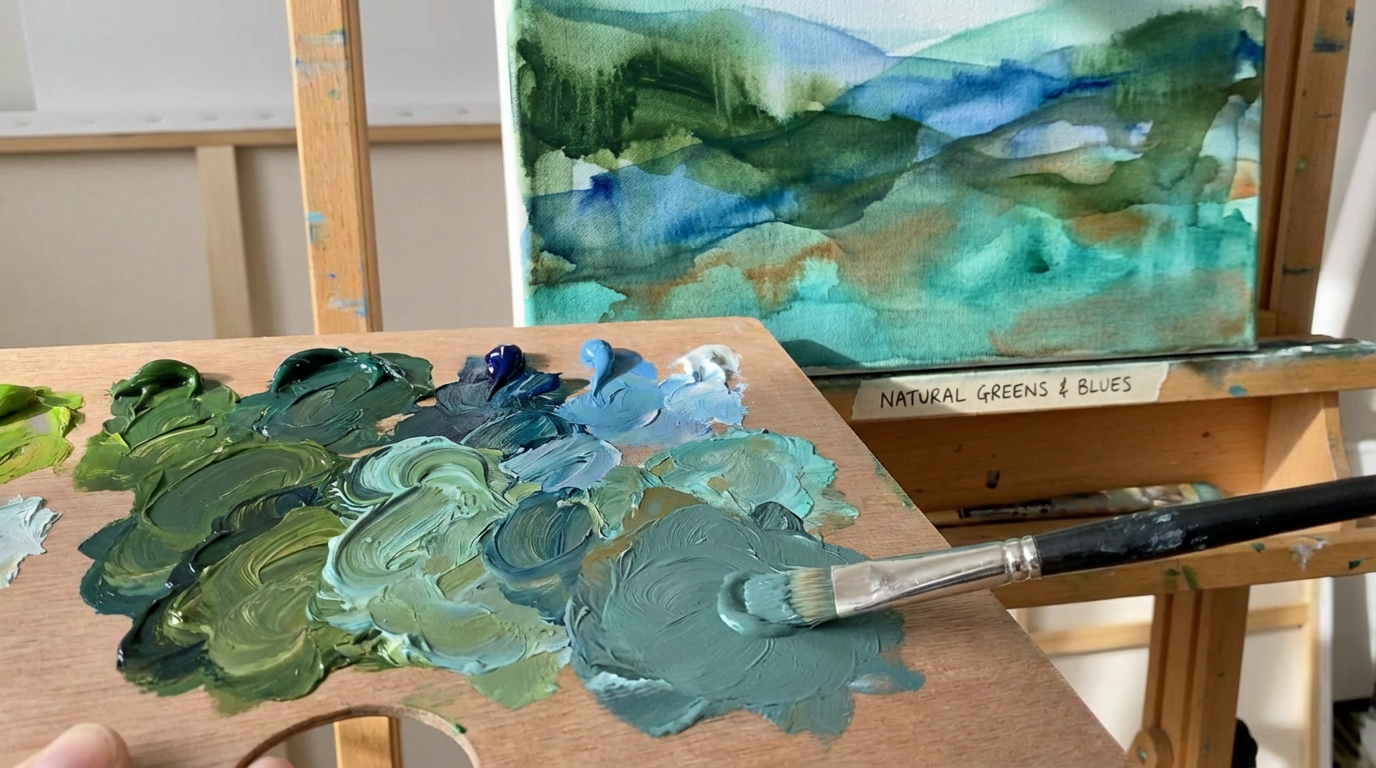

Landscape painting often fails or succeeds on one quiet detail. Color harmony. Specifically, how greens and blues are mixed. Nature rarely shows pure green or straight blue. Instead, these colors shift, breathe, and react to light, distance, and atmosphere. When painters rely on tube colors alone, landscapes can feel flat or artificial. That is where mixing natural greens blues becomes essential.
Think of nature like an orchestra. No instrument plays solo for long. Greens borrow from yellows, reds, and blues. Blues lean into gray, violet, or green depending on mood and distance. Once you stop chasing perfect color and start building relationships, landscapes suddenly feel alive.
This article walks you through mixing natural greens blues in a way that feels intuitive rather than technical. You will learn how to see color differently, mix with purpose, and avoid the common traps that make landscapes look unnatural.
Why Tube Greens and Blues Rarely Work Alone
Paint manufacturers love convenience. Bright green tubes promise instant foliage. Strong blues suggest endless skies. Yet real landscapes rarely cooperate. Straight-from-the-tube greens often scream instead of whisper. Pure blues feel artificial under most lighting.
Nature filters color constantly. Sunlight warms surfaces. Shadows cool them. Distance softens saturation. Because of this, premixed colors usually need adjustment.
When mixing natural greens blues, the goal is subtle variation. Even a field of grass contains dozens of green temperatures. The sky shifts from warm near the horizon to cooler overhead. Recognizing this complexity helps you paint what you see rather than what you assume.
Understanding Color Temperature in Natural Greens Blues
Temperature controls realism. Warm greens feel sunlit. Cool greens suggest shadow or moisture. Blues behave similarly. Warm blues feel closer. Cool blues recede.
Adding yellow warms green. Adding blue cools it. Red neutralizes green. These simple relationships guide nearly every mixture. Likewise, adding a touch of orange or red to blue can soften intensity and create atmospheric distance.
When mixing natural greens blues, always ask one question. Is this area warm or cool? That answer directs your hand more than any formula.
Building Greens from a Limited Palette
Many landscape painters discover freedom by using fewer colors. Instead of relying on multiple green tubes, they mix greens intentionally. Yellow plus blue forms the base. From there, adjustments create variety.
A lemon yellow with ultramarine creates cool, fresh greens. A warm yellow with a warmer blue produces olive tones. Add red to mute intensity. Add white carefully to control value without chalkiness.
This approach trains your eye. It also prevents color chaos. When greens share common ingredients, harmony follows naturally.
Mixing Natural Greens Blues for Sunlit Areas
Sunlight changes everything. Greens in direct light appear warmer and brighter. Blues in the sky near the horizon often lean warm as well.
To achieve this, introduce warmth deliberately. A touch of yellow or even red-orange can lift a green without making it garish. For blues, mixing in a hint of red or yellow softens intensity.
Avoid pure white when lightening. Instead, use lighter, warmer pigments. This preserves color life. Sunlit areas should feel luminous rather than chalky.
Mixing Natural Greens Blues for Shadow and Depth
Shadows are not simply darker. They are cooler, richer, and more complex. Green shadows often contain blue or violet. Blue shadows may carry hints of green or gray.
When mixing natural greens blues for shadow, reduce saturation first. Add complementary colors gently. This creates depth without muddying.
Value matters here. Darkening with black often kills color. Instead, use darker blues, reds, or earth tones. This keeps shadows vibrant and believable.
Using Earth Colors to Naturalize Greens and Blues
Earth pigments act like translators. They help bright colors speak the language of nature. Burnt sienna, raw umber, and yellow ochre quietly neutralize without overwhelming.
Adding a small amount of earth color to green instantly reduces artificial brightness. Blues benefit as well. Earth tones soften skies and water reflections.
This technique feels subtle. However, it dramatically improves realism. Many professional painters rely on earth colors for this reason alone.
Atmospheric Perspective and Color Mixing
Distance changes color perception. Far objects appear cooler, lighter, and less saturated. This principle guides mixing natural greens blues in landscapes.
Foreground greens tend to be warmer and more detailed. Background greens shift toward blue-gray. Likewise, distant blues fade and soften.
To achieve this, reduce contrast and saturation as elements recede. Mix more blue and gray into distant greens. Lighten values slightly. These changes create space without drawing lines.
Avoiding the “Neon Green” Problem
Neon green haunts many landscapes. It usually comes from too much yellow and too little neutralization. Nature rarely glows like a highlighter.
The solution involves restraint. Always test green mixtures next to each other. Compare them to reference or observation. If a green jumps forward aggressively, it likely needs calming.
Adding red or earth tones fixes this quickly. Sometimes, a tiny adjustment makes a massive difference. Trust your eye more than the tube label.
Mixing Blues for Sky with Natural Variation
Skies are not flat blue sheets. They shift constantly. Near the horizon, blues warm and lighten. Overhead, they deepen and cool.
When mixing natural greens blues for skies, avoid using one mixture across the entire area. Gradually adjust temperature and value. Introduce subtle color shifts.
Adding a touch of yellow or red near the horizon creates atmospheric glow. Adding a bit of violet or green cools upper areas. These variations keep skies alive.
Water and Reflected Color Mixing
Water reflects its environment. It borrows sky color, nearby foliage, and ground tones. Rarely is water purely blue or green.
When mixing natural greens blues for water, observe reflections closely. Calm water mirrors sky color. Moving water breaks reflections into fragments.
Adding green to blue often works better than using blue alone. Introducing earth tones grounds reflections. Keep edges soft to suggest movement.
How Light Conditions Affect Color Mixing
Morning light warms landscapes. Evening light exaggerates warmth and contrast. Overcast conditions flatten saturation and cool colors.
Adjust mixtures accordingly. Under warm light, greens lean yellow. Blues soften. Under cool light, greens shift toward blue. Blues deepen.
Being aware of light conditions helps prevent mismatched color relationships. Mixing natural greens blues always depends on context.
Developing a Personal Green and Blue Palette
Every painter sees color differently. Some prefer muted landscapes. Others love rich saturation. Developing a personal approach takes time.
Experiment with mixing charts. Create rows of greens and blues using different combinations. Label results. Over time, patterns emerge.
This practice builds confidence. Instead of guessing, you recognize mixtures instinctively. That familiarity speeds decision-making during painting.
Practicing Color Mixing Without Pressure
Practice away from finished paintings. Use sketchbooks or scrap surfaces. Mix freely without expectation.
Focus on observation. Compare mixtures to nature photos or life studies. Adjust gently. Notice how small changes affect mood.
This low-pressure exploration strengthens understanding. When it matters most, your hands already know what to do.
Conclusion
Mixing natural greens blues is less about formulas and more about awareness. Nature rarely uses pure color. It blends, softens, and shifts constantly. When you embrace that complexity, landscapes gain depth and believability.
By understanding temperature, value, and context, you gain control. Greens stop shouting. Blues start breathing. With practice, mixing becomes intuitive rather than technical. At that point, color stops being a struggle and starts becoming a language you speak fluently.
FAQ
1. Why do my greens look unnatural in landscapes?
They are often too saturated and lack neutral tones found in nature.
2. What colors help mute bright greens effectively?
Red, burnt sienna, and raw umber work well for neutralizing greens.
3. Should I avoid green paint tubes entirely?
No, but they work best when modified rather than used alone.
4. How can I make distant landscapes look realistic?
Use cooler, lighter, and less saturated green and blue mixtures.
5. Does lighting really affect how I should mix colors?
Yes, light temperature changes how greens and blues appear dramatically.
Leave a Comment