
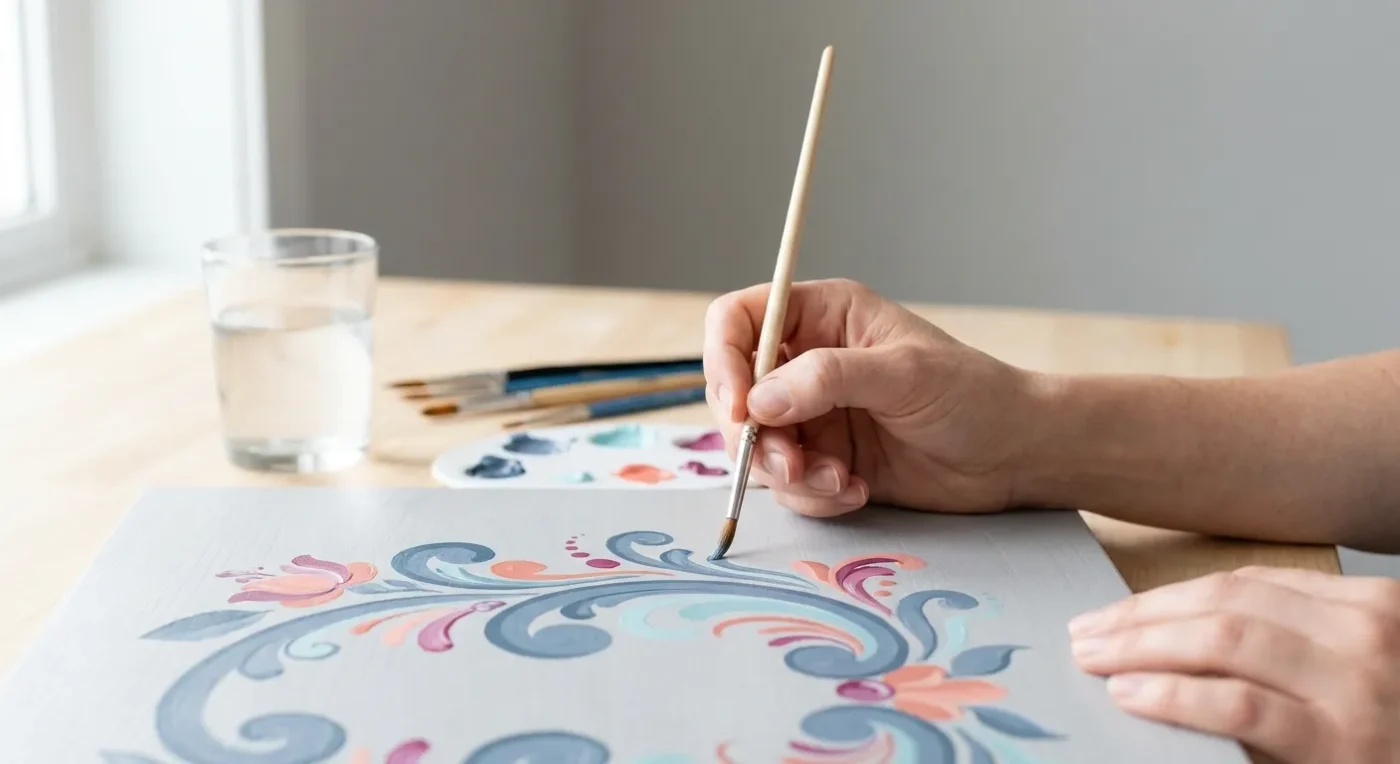

Mastering Rosemaling Strokes: Your Beginner’s Guide to Norwegian Folk Art
If you’ve admired the intricate beauty of Norwegian folk art, it’s time to start mastering rosemaling strokes with confidence. Rosemaling, meaning “rose painting,” is a traditional decorative painting style that originated in Norway, characterized by its flowing lines, scrollwork, and floral motifs. While it may appear complex, with foundational guidance and practice, any hobbyist can begin to create these stunning designs. PaintWorksMag is here to demystify the process and help you embrace this rich artistic heritage.
The Allure of Rosemaling: A Timeless Tradition
Rosemaling has captivated artists and enthusiasts for centuries, evolving from regional variations like Telemark, Hallingdal, and Rogaland. Today, this beautiful art form continues to thrive, with its traditional techniques finding new life in modern homes and crafts. The sustained interest in detailed, handcrafted projects aligns perfectly with the current trend of seeking unique and personal touches in our living spaces. Understanding the basics of rosemaling brushwork is your first step into this rewarding world.
Essential Tools for Your Rosemaling Journey
Before you begin, gather these fundamental tools:
- Brushes: A good quality round brush (sizes 0-3) for fine lines and scrollwork, and a flat brush (sizes 4-8) for broader strokes and shading are essential. Synthetic bristles are often preferred for their spring and durability.
- Paints: Water-based acrylics are ideal for beginners due to their ease of use, quick drying time, and vibrant colors. Look for a palette of traditional Rosemaling colors: warm reds, deep blues, leafy greens, and earthy browns, often contrasted with cream or white.
- Surfaces: Practice on smooth, non-porous surfaces like sealed wood panels, heavy cardstock, or even ceramic tiles. As you gain confidence, you can move to decorative items like wooden plates, boxes, or furniture.
- Palette: A non-absorbent surface like a ceramic tile or a plastic palette works best for mixing colors.
- Water Container & Paper Towels: For cleaning brushes and managing paint consistency.
Foundational Rosemaling Strokes: Step-by-Step
The core of rosemaling lies in mastering a few basic strokes that combine to form elaborate patterns. Let’s break down the C-stroke, S-stroke, and basic scrollwork.
The C-Stroke: Building Your Curves
The C-stroke is a fundamental curved stroke that forms the basis of many floral and leaf elements. It’s all about pressure control.
- Load your brush: Dip your round brush into paint, ensuring it’s fully loaded but not dripping.
- Initial touch: Touch the tip of your brush to the surface, applying light pressure.
- Increase pressure: As you curve the stroke, gradually press down on the brush to widen the line.
- Decrease pressure: As you complete the curve, gradually lift the pressure, returning to a fine tip. This creates a tapered, elegant curve. Practice making these curves in both directions.
The S-Stroke: Elegant Flow and Movement
The S-stroke is another essential element, bringing graceful flow to your designs. It combines two C-strokes in opposite directions, creating a fluid, serpentine line.
- Start with light pressure: Begin with the tip of your round brush, applying minimal pressure.
- Curve and press: As you begin the first curve of the ‘S’, gradually increase pressure, then decrease it as you reach the middle point.
- Reverse curve: Without lifting your brush, immediately begin the second curve in the opposite direction, increasing and then decreasing pressure to finish with a fine tip. The key is a continuous, smooth motion.
Basic Scrollwork: Connecting Elements
Scrollwork acts as the connective tissue in rosemaling, linking different motifs and adding intricate detail. It often uses variations of the C and S strokes.
- Start with a C or S stroke: Many scrolls begin with one of these foundational movements.
- Extend and connect: From the end of your initial stroke, extend a fine line, then add another small curve or flourish. Think about how the lines flow into each other.
- Vary thickness: Use pressure control to create varying line thicknesses within your scrollwork, adding visual interest.
Practice these foundational rosemaling brush techniques repeatedly. Consistency in pressure and smooth transitions are key to achieving the authentic look of Norwegian folk art painting. Remember, every master began with these simple steps.
Understanding Rosemaling Design Principles
Beyond individual strokes, successful rosemaling involves understanding how elements are arranged. Typically, designs feature a central motif, often a large flower or scroll, with smaller elements radiating outwards. Symmetry is frequently used, though not strictly required in all styles. For instance, the Telemark style is known for its asymmetrical, flowing compositions, while the Hallingdal style often features more structured, symmetrical patterns. Knowing these nuances will help you in mastering rosemaling strokes within a larger artistic context.
Color choice also plays a significant role. Traditional palettes are rich and earthy, but contemporary artists sometimes experiment with brighter hues while retaining the classic forms. Learning about historical examples of rosemaling can provide excellent inspiration for both color and composition.
Building Complexity: Leaves, Flowers, and Borders
Once you’re comfortable with the basic strokes, you can combine them to form more complex elements.
Creating Leaves
Leaves are often formed using two opposing C-strokes, meeting at a point. You can add a central vein with a fine line and even some delicate shading using a slightly lighter or darker shade of green.
- First C-stroke: Paint a C-stroke, tapering at both ends.
- Second C-stroke: Mirror the first C-stroke on the opposite side, creating a leaf shape.
- Add detail: With a fine brush, add a central vein and perhaps some small decorative dots or swirls at the base.
Developing Basic Flowers
Simple rosemaling flowers often consist of multiple C-strokes arranged in a circular pattern around a central point. Think of creating petals.
- Central dot: Start with a small dot as the center of your flower.
- Petals: Around this dot, paint several C-strokes, curving outwards to form petals. Vary the pressure to give each petal dimension.
- Add inner details: Once dry, you can add smaller C-strokes or dots inside the petals for more intricate detail.
Designing Borders and Fillers
Borders often utilize repetitive S-strokes or small C-stroke chains. Filler elements, like small dots, teardrops, or tiny scrolls, are used to fill empty spaces and add richness without overwhelming the main design. These elements are crucial for achieving the density and intricacy characteristic of traditional Norwegian folk art painting. Consider exploring our Glossary of Terms for more decorative art vocabulary.
The Importance of Practice and Patience
Like any artistic skill, mastering rosemaling strokes requires consistent practice. Don’t be discouraged if your first attempts aren’t perfect. Focus on the process, enjoy the meditative aspect of repetitive brushwork, and celebrate small improvements. Set aside dedicated time each week for practice. Start with simple exercises, filling pages with C-strokes and S-strokes before moving on to combining them into more elaborate designs. Remember, patience is a virtue in decorative painting.
Many artists find it helpful to trace existing patterns initially to get a feel for the flow and rhythm of the designs. As your hand becomes more accustomed to the movements, you can gradually move towards freehand work. This methodical approach is vital for anyone aiming to truly succeed at rosemaling painting techniques.
Overcoming Common Challenges
Beginners often encounter similar hurdles. One common issue is inconsistent paint consistency. If your paint is too thick, it will drag; too thin, and it will be watery and lose its opacity. Experiment with adding a tiny amount of water to your acrylics until they flow smoothly from the brush, maintaining their color intensity. Furthermore, controlling brush pressure can be tricky. Practice applying varied pressure on a scrap surface until you can reliably achieve both fine lines and broad strokes with a single brush movement. For more advanced techniques like achieving luminous depth, you might find our article on Mastering Glazing Techniques helpful, as similar principles of layering and control apply.
Expanding Your Rosemaling Horizons
Once you’ve gained confidence in mastering rosemaling strokes and basic compositions, consider exploring the distinct regional styles. Each style, such as Telemark, Hallingdal, Rogaland, and Gudbrandsdal, has its unique characteristics, color palettes, and preferred motifs. Studying these variations can broaden your understanding and inspire new creative directions. For example, Telemark is known for its dramatic, free-flowing scrolls and often incorporates fantastical creatures, while Hallingdal is more symmetrical with heavier, more defined forms. Learning about these different approaches can significantly enhance your journey in Norwegian decorative painting.
You might also consider joining a local folk art painting group or taking an online course. Learning from experienced instructors and connecting with fellow enthusiasts can provide invaluable feedback and motivation. There are many communities dedicated to traditional painting styles that offer resources and encouragement for artists at all levels. Exploring the history of folk art painting, such as through resources like the Victoria and Albert Museum’s folk art collection, can also deepen your appreciation and understanding of the art form.
Bringing Rosemaling into Your Home
The beauty of rosemaling extends beyond canvas practice. Imagine transforming a plain wooden box, a serving tray, or even a small piece of furniture into a personalized work of art. Rosemaling can add a touch of timeless elegance and handcrafted charm to any item. This aligns wonderfully with the trend of upcycling and personalizing home decor. If you enjoy giving new life to old objects, you might also be interested in our guide on From Drab to Fab: Upcycling Everyday Objects with Decorative Paint.
Start with smaller, manageable projects. A simple wooden coaster or a small picture frame can be a great way to showcase your developing skills in Norwegian folk art painting. As you grow more confident, you can tackle larger pieces, creating family heirlooms that celebrate this rich tradition.
Conclusion: Your Journey to Rosemaling Mastery
Embarking on the journey of mastering rosemaling strokes is a rewarding artistic endeavor. From understanding the historical significance to selecting the right tools and meticulously practicing each curve and scroll, every step brings you closer to creating beautiful Norwegian folk art. Remember that dedication, patience, and a willingness to learn are your most valuable assets. With PaintWorksMag’s guidance, you have a clear path to confidently create stunning rosemaling designs. Keep practicing, keep exploring, and most importantly, enjoy the creative process of bringing this timeless art form to life. Your hands are now ready to begin painting beautiful rosemaling patterns.
FAQ Section
What is rosemaling?
Rosemaling, meaning “rose painting,” is a traditional Norwegian decorative folk art characterized by its flowing lines, scrollwork, and floral motifs. It typically uses oil or acrylic paints on wood and features distinct regional styles.
What tools do I need to begin rosemaling?
To start painting rosemaling, you’ll need good quality round and flat brushes, water-based acrylic paints in traditional colors (reds, blues, greens, browns, cream), smooth practice surfaces like sealed wood or heavy cardstock, a palette, water, and paper towels.
How do I practice the basic brush movements for this art form?
Practice the fundamental C-stroke and S-stroke by focusing on pressure control with your brush. Start with light pressure, gradually increase to widen the line, and then decrease to taper it. Repeat these strokes until you achieve smooth, consistent curves.
Are there different styles of Norwegian folk painting?
Yes, there are several distinct regional styles of Norwegian folk painting, including Telemark, Hallingdal, Rogaland, and Gudbrandsdal. Each style has its own unique characteristics, preferred motifs, and color palettes.
Can I use rosemaling to decorate items in my home?
Absolutely! Once you gain proficiency in these painting techniques, you can apply them to decorate various items like wooden boxes, plates, furniture, or trays. It’s a wonderful way to add a personalized, handcrafted touch to your home decor.