
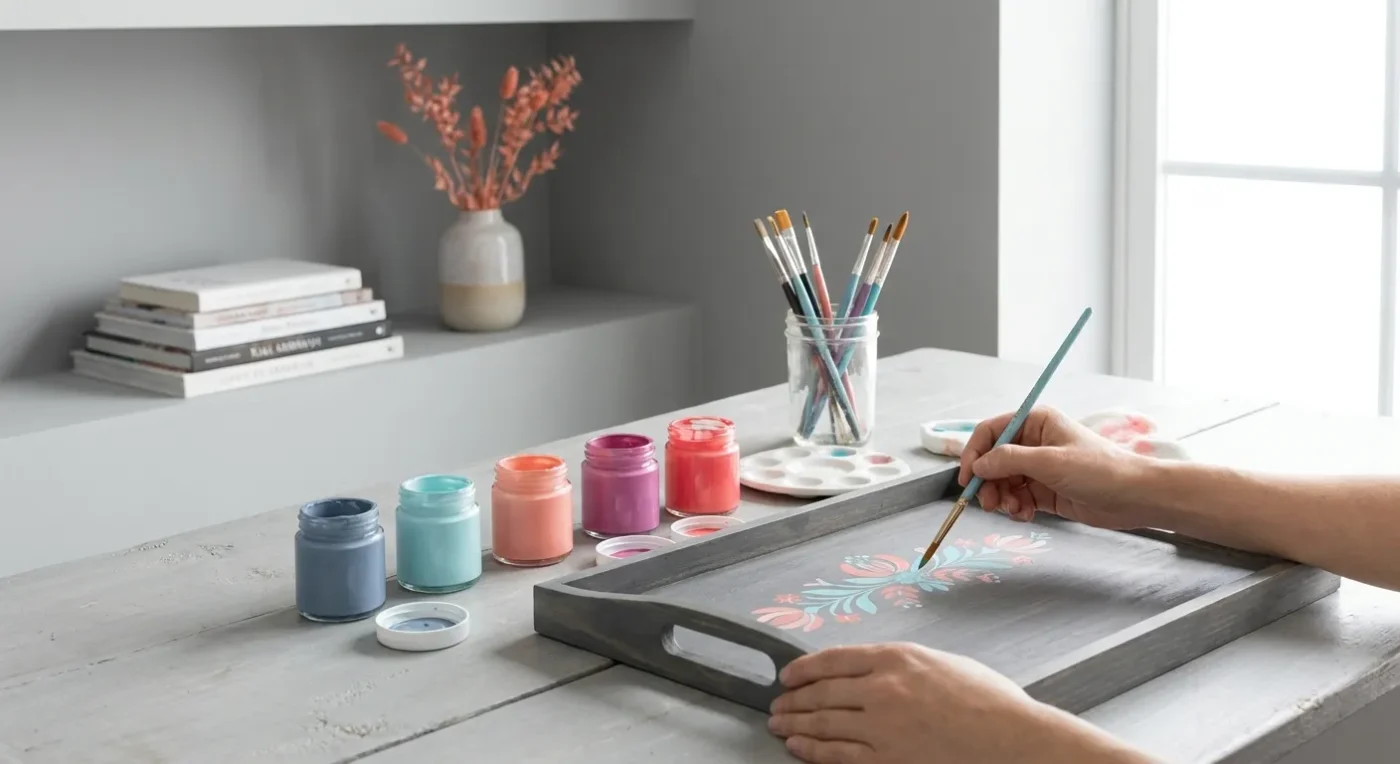

Building confidence in decorative painting starts with understanding the foundational movements, and mastering basic folk art brushstrokes is key. The beauty of folk art often lies in its deceptive simplicity; intricate designs are frequently built from a combination of just a few fundamental strokes. If you have ever admired a beautifully painted toleware tray or a charming floral design and wondered how it is done, you are about to discover the secrets. At Paint Works Mag, we are here to guide you through these essential techniques, transforming your brush into a tool of expressive creation.
The Foundation: Loading Your Brush Correctly
Before you even touch the surface, learning to load your brush properly is crucial for achieving clean, consistent strokes. First, dip your brush into clean water (for acrylics), then blot excess water on a paper towel. Next, pick up paint by dipping the tip of your brush into the color. Afterward, gently press and turn it on your palette to work the paint into the bristles, shaping the tip. You want enough paint for a smooth flow, but not so much that it is clumpy. Furthermore, consistent loading ensures your brush delivers paint evenly across your surface, which is vital for all types of decorative painting. Therefore, take your time with this initial step; it truly sets the stage for successful painting.
The Workhorses: Essential Brushstrokes to Master
Let us break down the basic folk art brushstrokes that form the backbone of countless designs. These foundational movements will equip you with the skills needed to tackle more complex projects. Moreover, understanding these strokes will help you deconstruct existing folk art pieces, revealing their underlying simplicity. We will explore several key strokes, each with its unique application and technique. Practice is paramount, as you will discover, for developing muscle memory and control.
The Comma Stroke (Using a Round Brush)
The comma stroke is perhaps the most fundamental and versatile stroke in folk art, perfect for leaves, petals, and decorative flourishes. This stroke is characterized by its tapering shape, thick at one end and thin at the other. Consequently, it creates a sense of movement and organic form. Mastering this stroke will significantly expand your decorative painting repertoire.
- Start with Pressure: Place the tip of your round brush on your surface, applying firm pressure to create a wide base.
- Lift and Drag: As you move the brush, gradually lift the pressure, allowing the bristles to come together into a fine point.
- Curve: Arc your stroke slightly to create the characteristic comma shape.
Practice Tip: Try varying the pressure and curve to create commas of different sizes and orientations. Combine them to form simple flowers or leaf clusters. Additionally, experiment with different brush sizes to see how they impact the stroke’s appearance. Remember, consistency comes with repetition.
The C-Stroke and S-Stroke (Using a Flat or Angled Brush)
These strokes are essential for creating graceful scrolls, borders, and the edges of larger elements. They add elegance and fluidity to your designs. In fact, many traditional folk art patterns rely heavily on these smooth, continuous curves. Mastering them will enhance the overall sophistication of your work.
- C-Stroke: Load your flat or angled brush. Place one corner of the brush down, apply light pressure, and sweep in a smooth ‘C’ curve. You can vary the width by changing pressure or the angle of your brush.
- S-Stroke: This is essentially two C-strokes connected. Start a C-stroke, then reverse the curve to create an ‘S’ shape. Keep it fluid and connected.
Practice Tip: Work on keeping your curves smooth and consistent. These strokes are all about flow and control. Furthermore, practice making them in both directions to ensure versatility. Consider how these strokes can form the basis for elegant lettering or intricate scrollwork, which are common in folk art.
The Liner Stroke (Using a Liner Brush)
For fine details, outlines, dots, and delicate lettering, the liner brush is indispensable. It allows for precision that other brushes cannot achieve. Therefore, understanding how to use it effectively is crucial for adding finishing touches to your projects. This stroke demands a lighter touch and thinned paint.
- Thin Your Paint: Liner brushes work best with paint thinned to an ink-like consistency (add a drop of water or thinning medium).
- Load Evenly: Roll the brush in the thinned paint on your palette until the bristles are fully saturated and come to a fine point.
- Consistent Pressure: Apply very light, consistent pressure as you draw your line. Let the thinned paint flow smoothly from the brush.
Practice Tip: Try drawing long, continuous lines without lifting your brush. Practice making dots of varying sizes by gently touching the tip of the brush to the surface. These delicate applications are fundamental to many decorative styles. For further exploration of detailed work, you might find our guide on Detailing with Precision: Simple Stenciling Techniques for Folk Art useful, as it complements brushwork for intricate designs.
Beyond the Basics: Combining Strokes for Complex Designs
Once you are comfortable with the individual basic folk art brushstrokes, the real magic begins when you combine them. Many seemingly complex folk art designs are merely arrangements of these simple elements. For example, a rose can be created from multiple comma strokes, while borders often use repeating C-strokes. Experimentation is highly encouraged at this stage.
Building Flowers and Leaves
Let us consider how to build common folk art motifs using your newly acquired skills. For instance, a simple daisy can be formed by arranging small comma strokes around a central dot. Leaves can be single comma strokes or a series of overlapping ones. Moreover, adding a delicate liner stroke for a stem or vein brings these elements to life. This process of combining basic painting techniques allows for endless creative possibilities.
Creating Scrolls and Borders
The C-stroke and S-stroke are perfect for creating flowing scrolls and decorative borders. Practice connecting these strokes seamlessly to form continuous patterns. You can vary the pressure to create thick and thin areas within your scrolls, adding visual interest. Furthermore, consider how repeating these patterns can adorn the edges of trays, boxes, or furniture pieces, transforming ordinary objects into works of art. Understanding Beyond Aesthetics: Uncovering the Meaning of Decorative Motifs can provide inspiration for your designs.
Essential Tips for Mastering Folk Art Brushstrokes
To truly master these painting techniques, keep a few key principles in mind. These tips will help you refine your skills and overcome common challenges. Consequently, your progress will be more consistent and enjoyable.
Consistent Paint Consistency
Maintaining the right paint consistency is paramount. If your paint is too thick, your strokes will be clumpy and hard to control. If it is too thin, it will be watery and lose its opacity. Therefore, always aim for a creamy, ink-like consistency for most strokes, adjusting slightly as needed. This ensures smooth flow and vibrant color.
Proper Brush Care
Your brushes are your most important tools. Clean them thoroughly after each painting session, shaping them back to their original form. A well-maintained brush performs better and lasts longer. Conversely, neglected brushes can become stiff and unusable, hindering your ability to produce clean basic folk art brushstrokes. For advice on preparing various surfaces for your art, consult Beyond Canvas: How to Paint Different Surfaces for Decorative Art.
Practice, Practice, Practice
There is no substitute for practice. Dedicate regular time to working on your strokes. Start with simple exercises, repeating each stroke until it feels natural. Then, gradually move on to combining them into designs. Remember, every master artist started with the basics. Consistency in practice builds confidence and skill over time. Consider setting up an efficient workspace, as detailed in Craft Your Comfort: Setting Up an Ergonomic Home Painting Studio, to make your practice sessions more enjoyable.
Observe and Learn
Look at examples of folk art, both traditional and contemporary. Observe how artists use these fundamental strokes to create their unique styles. There are many resources available, including online galleries and art history books. For example, the American Folk Art Museum offers extensive collections that showcase the diverse applications of these techniques. Analyzing these works can provide valuable insights into composition and stroke application. Furthermore, platforms like Pinterest can be great for visual inspiration.
Troubleshooting Common Brushstroke Challenges
Even with focused practice, you might encounter some common issues. Do not be discouraged; these are normal parts of the learning process. Addressing them directly will help you improve your technique for these foundational brushstrokes.
Wobbly Lines or Uneven Pressure
If your lines are wobbly, it often indicates a lack of control or inconsistent pressure. Try holding your brush further back from the ferrule for a lighter touch, or closer for more control. Practice drawing lines slowly and deliberately. Moreover, ensure your hand is supported, perhaps by resting your pinky finger on the surface, to stabilize your movements.